Removing a concrete driveway, patio or slab: what to expect
By Sofia Vogel · Updated 2026-08-15
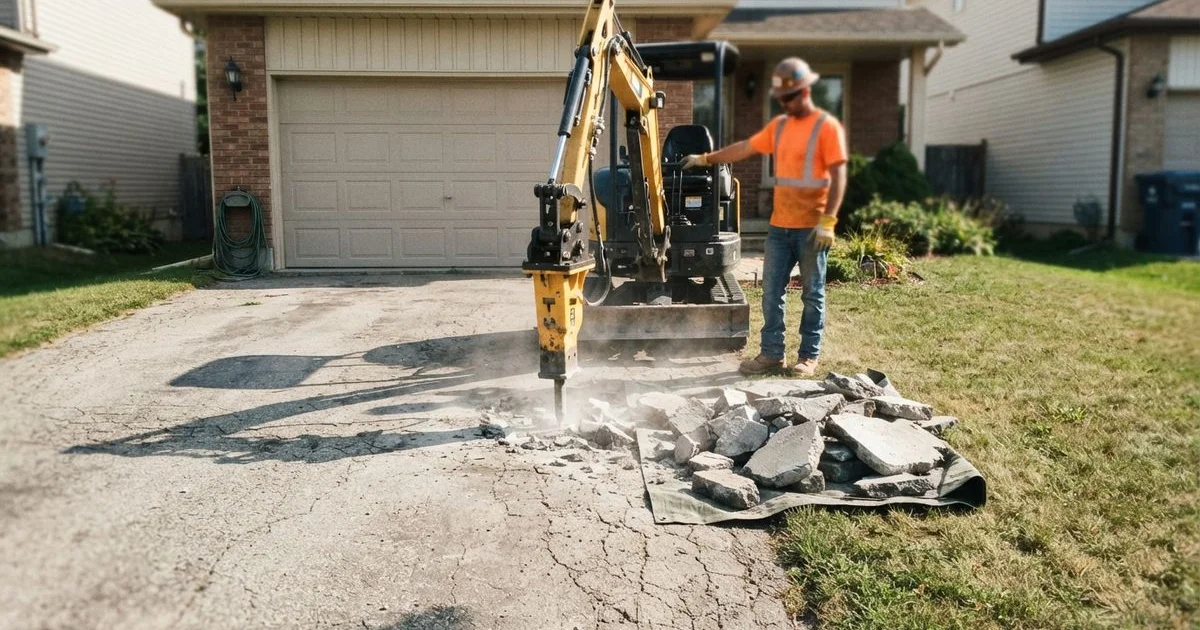
Removing an old concrete driveway, patio, or slab is one of the more straightforward jobs in demolition, but it’s not quite as simple as it might look from the sidewalk. Here’s what actually happens and what changes the cost.
The removal process
- Assessment. A contractor checks the slab’s thickness, whether it’s reinforced with rebar or wire mesh, and confirms access for equipment.
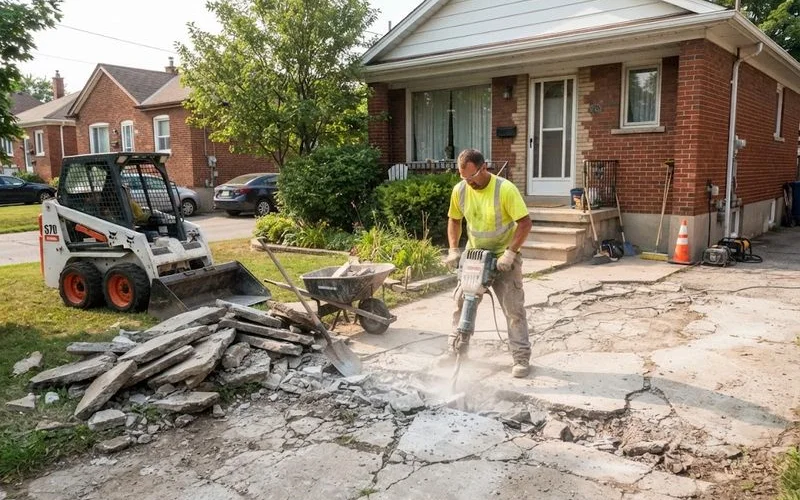
- Breaking up the concrete. For most residential driveways, a hydraulic breaker or a smaller excavator attachment breaks the slab into manageable pieces. Thicker or reinforced slabs take more time and sometimes a larger attachment.
- Separating rebar. If the slab has embedded steel reinforcement, it’s pulled out or cut away from the broken concrete pieces so both materials can be handled and disposed of, or recycled, appropriately.
- Loading and haul-away. Broken concrete is loaded into a truck or bin and hauled either to a recycling facility that processes it into aggregate, or to a landfill or transfer station if recycling isn’t available locally.
- Grading the area. Once the slab is gone, the underlying base is graded, especially if new paving, landscaping, or a replacement structure is planned.
A full house teardown involves a lot more than a single slab; the house demolition process guide covers the added permit, disconnection and grading steps that come with it.
What changes the cost and timeline
- Slab thickness and reinforcement. A standard driveway slab is quicker to remove than a reinforced commercial-grade pad or an old foundation slab.
- Access for equipment. A driveway with easy street access is faster to clear than one behind a narrow gate or shared laneway.
- Recycling vs landfill disposal. Recycling concrete is often cheaper per load than landfill tipping fees, and better for the project’s environmental footprint, but not every area has a nearby facility that accepts it.
- Size of the area. A single-car driveway is a different job than a full parking lot or a large patio, both in time and in disposal volume.
| Job type | Typical duration | What affects it most |
|---|---|---|
| Single-car driveway | Half day to 1 day | Access, slab thickness |
| Double driveway or large patio | 1-2 days | Reinforcement, disposal volume |
| Parking lot or commercial pad | Several days | Thickness, drainage, base material |
Before you schedule removal
If you’re replacing the driveway or patio with something new, confirm the base and grading plan before removal starts, since some replacement surfaces need different sub-base preparation than what’s currently there. If drainage on the property currently relies on the slope of the existing slab, ask your contractor how the new grading will handle water runoff, since this is a common thing that gets overlooked until the first rainstorm after the work is done.
For anything beyond a simple slab removal, like an old foundation with attached concrete, check whether hazardous material testing applies; older commercial pads in particular sometimes have contamination history worth confirming before disposal.
Asphalt driveways and parking areas
Asphalt removal follows a similar sequence to concrete but generally comes apart faster since it doesn’t have the same rigidity or reinforcement. It’s also more commonly recycled, since asphalt millings are widely accepted by paving suppliers for reuse. If your project involves both an old asphalt driveway and a concrete walkway or patio, ask your contractor whether they handle both materials or whether it needs two separate crews.
What to check before you sign a quote
- Does the quote include haul-away and disposal, or is that priced separately?
- Will the contractor recycle the concrete or asphalt, and does that change the price compared to landfill disposal?
- Is grading and base preparation for a replacement surface included, or only the removal itself?
- How will they protect existing landscaping, fencing, or neighbouring surfaces during the work?
Common surprises during removal
Older properties sometimes have more than one layer of concrete or asphalt stacked from past repaving, or a slab thicker than it appears from the surface. Buried utility lines under a driveway are another common surprise, which is one more reason a utility locate request matters even for what looks like a simple surface removal. A contractor who asks about the property’s history before quoting is usually accounting for these possibilities rather than assuming the simplest scenario.
You can browse concrete and asphalt demolition specialists in Ontario on the Ontario Excavation & Demolition Directory and see how listings are scored for completed-job history in our ranking methodology.
FAQ
- How long does it take to remove a concrete driveway?
- A standard single-car driveway is often removed in half a day to a full day, including debris haul-away. Larger driveways or reinforced slabs take longer.
- Can I recycle old concrete instead of sending it to landfill?
- Yes, many contractors crush and recycle concrete as aggregate rather than landfilling it, which is often cheaper and better for the environment. Ask whether your contractor offers this.
- Do I need a permit to remove a driveway or patio?
- Usually not for simple removal, but check if you're also changing drainage, grading, or planning new hardscaping that alters the lot in a way your municipality regulates.
- Is rebar in old concrete a problem for removal?
- It adds a step, not a major obstacle. Contractors use attachments designed to break concrete and separate rebar for recycling as part of the standard process.